The Future of Events: AI, Sustainability and Biometrics

Summer is event season. From sold-out concerts and international sporting competitions to bustling festivals and global conferences, millions of people are gathering to experience something memorable. Yet while attendees see the spectacle, organisers are managing an increasingly complex balancing act behind the scenes: delivering seamless experiences, strengthening security, reducing environmental impact and making smarter use of data.
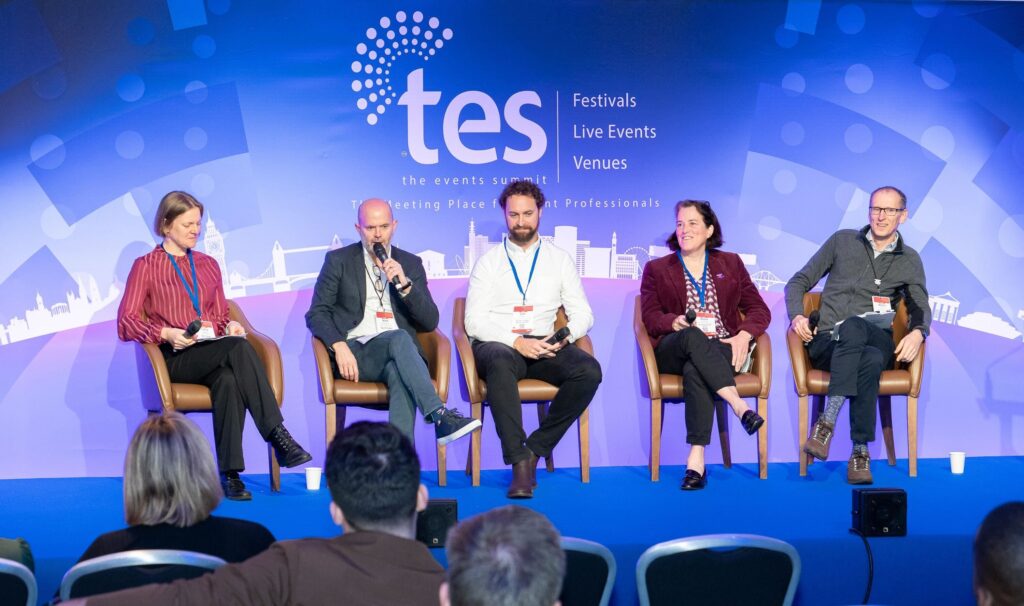
As the scale and expectations of events continue to grow, so too does the importance of the technology and operational strategies that support them. During the Wiz-Team Client Workshop held in Lausanne this spring, event professionals from across sport, government and the corporate sector came together to discuss some of the biggest forces shaping the industry’s future. Their conversation revealed a sector embracing change – and asking important questions about where events go next.
It was a candid, wide-ranging conversation facilitated by Wiz-Team Global Sales Manager James Taylor, who opened each theme with questions designed less to prompt definite answers than to surface honest reflection and experience. Three themes dominated: artificial intelligence (AI), sustainability, biometrics and security. Together, they paint a picture of an industry in motion – and one with some significant shifts still to come.
Artificial intelligence: from workflow tool to strategic asset
AI has arrived in the events industry. Not with a bang, but quietly, through the back door of daily workflows. The question now is how far it goes.
In the room, examples ranged from the practical to the genuinely surprising. One organisation described an internal AI adoption programme already embedded in their operations, using the technology to streamline processes, manage documentation and handle tasks that previously required significant human effort. On the supplier side, Wiz-Team’s own development team shared how AI is now woven into their coding, documentation and review processes. “There is no way back from a development perspective”, noted Wiz-Team’s Chief Technology Officer Stefano Rigat.
Perhaps the most striking example came from the International Skating Union, which described extensive testing of AI and computer vision technologies to improve consistency in technical scoring, feeding results through an algorithm after the judging to identify the best judges via the data. It is a long way from automating an email template, and it illustrates just how broad the technology’s potential reach is.
For Abhishek Jain, CEO of fielddrive, the conversation has two distinct dimensions: “We use AI as a co-worker on the software side; there’s no two ways about it.” But he also sees AI shifting the relationship between event data and the people managing it, from passive reporting to active, on-demand insight. As he put it: “AI can surface real insights about what actually happened during your event.”
The real opportunity lies for many in applying AI not just to translation and workflow, but to processing the vast amounts of participant data these events generate and making that data work harder for the people running them.
Sustainability: from policy to practice
If AI is the theme the industry is still figuring out, sustainability is the one where tangible action is already happening.
James Taylor’s questions to the room revealed a wide spectrum of approaches, from organisations still at the awareness stage to those with mature, measurable programmes in place. What was clear is that “sustainability” means different things to different people, and that the practical challenges are often more complex than the headline commitments suggest.
Several organisations shared concrete examples of genuine progress. The European Commission described implementing a carbon footprint calculator, developed in collaboration with Wiz-Team, that allows participants to calculate the environmental impact of their travel to events. Others pointed to catering management as an area of meaningful impact, using Event-Works data to match meal provision more precisely to actual attendance, significantly reducing food waste at large-scale events.
On the accreditation side, Will Duggins, Managing Director of Orion Security Print, outlined how the industry is finding greener ground: “PVC has had a difficult reputation from a sustainability standpoint, and rightly so. We’re now working with fully recyclable polypropylene alternatives and recycled polyester wristbands that perform just as well operationally. The materials exist; it’s about making them the default rather than the exception.”
The question of digital accreditation also surfaced, prompting a nuanced response. Anh Nguyen, Wiz-Team’s Head of Account Services & Operations, noted that the shift is not as straightforward as it appears: not every participant has reliable smartphone access, and for many events, a visible physical credential remains a security requirement. “Accreditations are also souvenirs for some people,” she added. “There’s a human dimension to that which is easy to overlook.”
🎥 >> A glimpse into the future of accreditation—live and on demand.
Biometrics and security: a new imperative to be considered

Of the three themes, biometrics generated perhaps the most honest admission in the room: most sports organisations are simply not there yet.
The question as to who was using biometric authentication was first met with a revealing silence before the conversation opened up. The technology exists, it is being adopted in the corporate events space and in the governmental sector, and its proponents argue it is both faster and more secure than traditional credential checks. Yet a hesitation remains in sport.
Privacy concerns came up immediately, though Abhishek Jain sought to reassure on those arguments: “Biometrics gets a bad reputation because people assume it means storing photos or personal images. That’s not how it works. We store a biometric signature – a code, not an image. The data protection case for biometrics is actually stronger than people think, and the security benefits are significant.”
Biometrics hasn’t yet made it onto the priority list for most sport organisations – not because of principled objection, but because the perceived urgency isn’t there. That may change. As security requirements at major events continue to intensify, and as the technology becomes more accessible, the conversation may look quite different in the years ahead.
What does this mean for event professionals?
Taken together, the three themes point toward the same underlying shift: event management is becoming as much a data and technology discipline as a logistical one. The organisations furthest ahead on AI, on sustainability, on security, are those that have invested in understanding their data, building the right partnerships and asking the harder operational questions early.
For James Taylor, the value of conversations like this one lies in their honesty. “We’re lucky to speak with many different organisations every week,” he reflected. “Sustainability keeps coming up, so does AI, but what’s striking is how differently each organisation is approaching the same challenges. There’s a lot the industry can learn from itself, if it creates the space to do so.”
That, perhaps, is the most useful takeaway: not a single answer to where events are heading, but a clearer sense of the questions worth asking, and the peers worth asking them with.
#WizJourney